Onboarding Tour
A 10-minute hands-on tour: explore the Marketplace, open a module, import data, and save a first workflow. Open a project, then click 🎓 Academy in the workspace top bar. Cyto recommends it as the first course.
Available
For educators
A guided training space inside Karcytics, so students learn the software and the theory behind it, in the app, without touching their real project data.
What it is
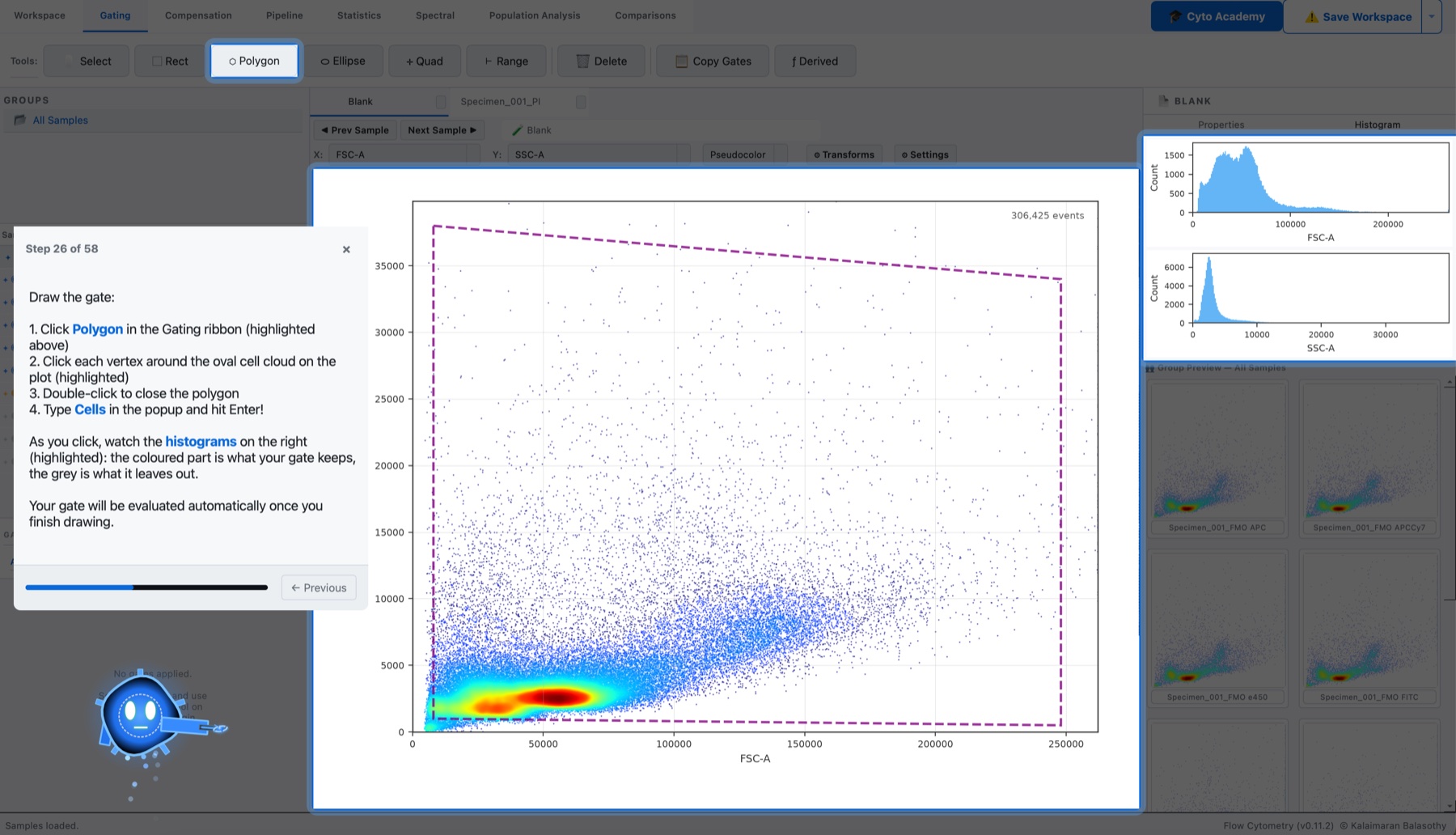
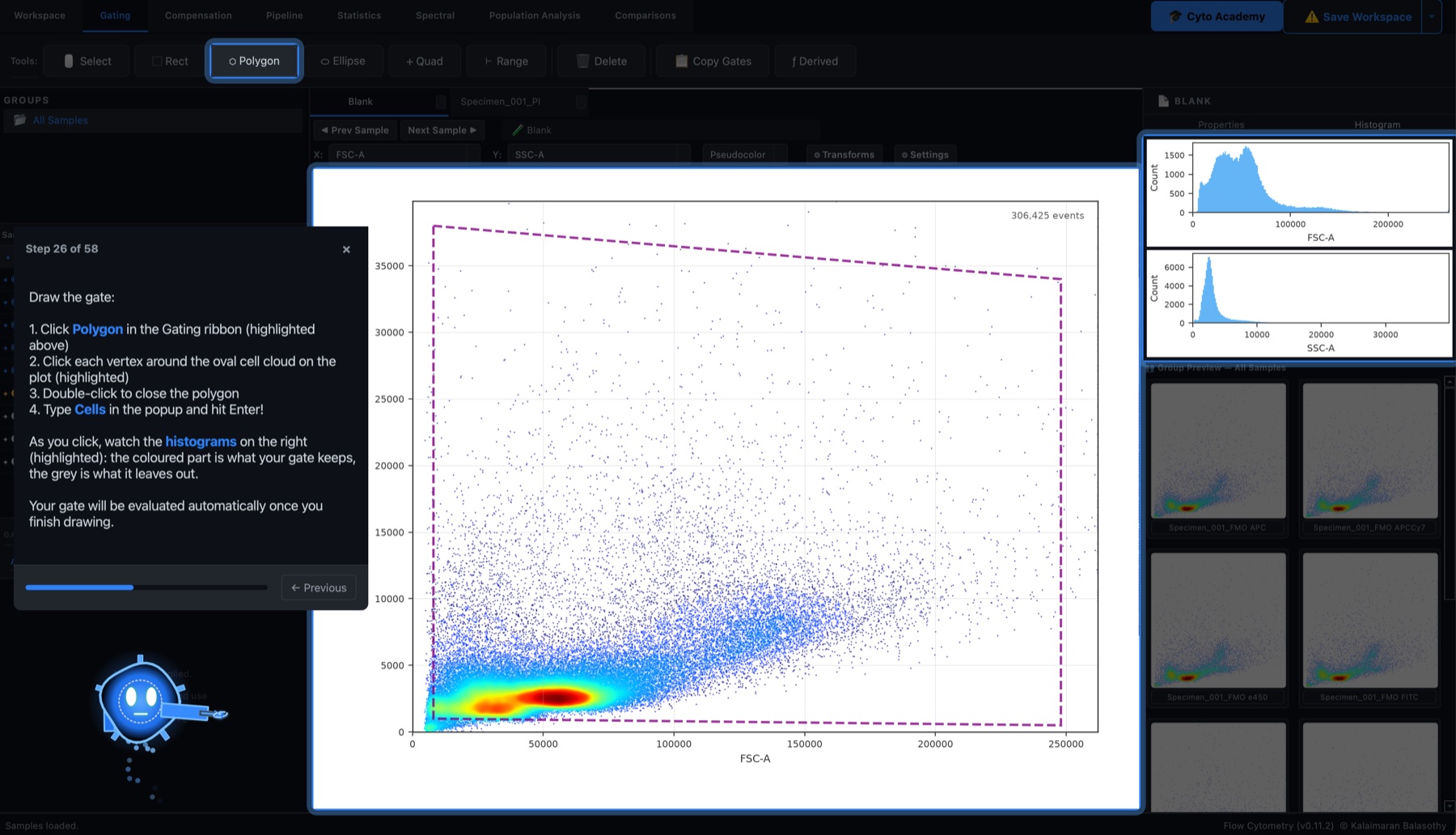
Cyto Academy is part of the Karcytics app. Cyto, the guide character, presents step-by-step tasks in the app and tracks progress locally, so students can stop and resume where they left off. Courses are built around workflows and practical tasks, not just menus.
It isn't a video or a static walkthrough. Karcytics checks the actual workspace as a student works — the shape of the gate they drew, the role they assigned, whether they saved — and only moves on once that real work checks out. A gate that's wrong gets deleted with an explanation; one that's right but misnamed gets renamed automatically, so nobody gets stuck on a typo.
What's in it
A 10-minute hands-on tour: explore the Marketplace, open a module, import data, and save a first workflow. Open a project, then click 🎓 Academy in the workspace top bar. Cyto recommends it as the first course.
Available
Guided lessons for individual analysis modules, one task at a time.
Flow Cytometry: 7 courses, about 5h 19m total. Other modules coming.
Closing projects safely, keeping backups, and sharing your work.
Available
Right now, module courses cover Flow Cytometry only. Over time, Cyto Academy will cover every module, so the same guided approach works for each one.
Built and ready today
Seven courses, each one opening the workspace the last one saved. No FCS files required — the Academy provisions its own realistic ten-file demo dataset the first time a student needs it. Courses 1 and 3 run a predict-then-confirm mystery (three unlabeled samples a student identifies from the evidence), and Courses 4 through 7 carry that into a real cross-check: UMAP and HDBSCAN against a student's own hand-gating, Sample Lens auditing every gate against that run, FlowSOM and PhenoGraph weighing in with second opinions, and a final statistical comparison of the hand-gated and unsupervised results.
Import files, tag every sample's role, draw a first gate from scatter alone, and learn why spillover happens before Compensation ever opens.
🔬 Flow Fundamentalist
Build a spillover matrix from your own FMO controls, fine-tune one value by hand, and gate Live Cells and Leukocytes on it.
⚖️ Signal Cleaner
Gate T-cells and B-cells two different ways, split T-cells into CD4/CD8 subsets with a single Quadrant gate, and use the evidence to solve which sample is which organ.
🧬 Immunophenotyper
Run UMAP and HDBSCAN on your own gated data with zero manual gates, then prove the result out against your own hand-gating with a Pipeline AND node.
🧠 Population Analyst
Backgate your whole gating strategy against Course 4's clusters, turn the cells no gate holds into real gates, read flags across every sample, and catch a bad gate edge the moment you draw it.
🔎 Gate Auditor
Run two more clustering methods on the cells UMAP already clustered — read FlowSOM's tree and PhenoGraph's cluster graph, see how each chooses its grain, then ask Sample Lens which findings all three methods agree on.
🩺 Second Opinion
Build a ratio parameter, then test whether your hand-gated and unsupervised populations really measure the same thing, with the Statistics table and Comparisons charts.
📊 Insight Reporter
Start to finish, the seven courses run about 5 hours 19 minutes — enough for a multi-week unit, with each course a natural weekly assignment. Short questions check understanding throughout, and a badge marks each course complete.
Who it's for
Learn the methods by doing them, without spending a week on setup or software licenses.
Give every student the same analysis, so a teaching lab's results are comparable from one term to the next.
Save your gating, pipelines, and normalization steps so you can re-run them and describe them exactly in your methods.
Consistent quantification across blots, images, and circuits, from one shared hub.
In a teaching lab
Tell us what your course needs. Your feedback decides which courses come next.